Archaeology - Prehistory
Prehistory is the period of human history for which we have no written
records. In order to learn about this time, we must rely on relics retrieved
from the ground. "Het Huis van de Aarde" houses objects from all periods
of prehistory, objects which were found in, or very close to, Wieringen
(eg. Wadden Sea, Wieringer Lake). Here are some of these objects.
 1.
The Palaeolithic: the early Stone Age. This is the time of the glaciers,
from about 100,000 years ago, to the arrival of the first farmers, about
3,500 B.C. Wieringen and the rest of the Netherlands looked quite
different then. During the last
ice age (ca. 100,000 to 10,000 A.D.) the glaciers didn't quite reach
the Netherlands, but their proximity did cause a tundra-like climate. The
North Sea was a dry, bare plain, where little grew. Only towards the end
of this period, from about 18,000 A.D. on, did the climate become warm
enough for permanent habitation to become possible in our region. Before
this time, there is speculation that small groups of nomadic hunter-gatherers
camped in Wieringen. Their primary source of food would have been the animals
of the ice age, particularly those that roamed the tundra: mammoth,
reindeer, wooly rhinoceros, giant deer. In the spring of 1995, land re-allotment
activities were underway near Hippolytushoef. Some of the workers unearthed
finds which revealed that people had walked here at least 35,000 years
ago. These people had used stone tools that, elsewhere in Europe, have
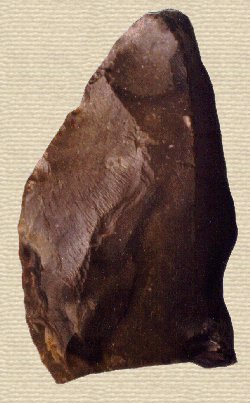
been associated with the Neanderthal culture. The picture on the left is
of a simple convex scraper, from the Mousterian period. Since the Neanderthals
died out about 35,000 years ago, it is highly probably that these finds
date to the same period as the majority of remnants of Pleistocene mammals
in the Wadden area, namely between 60,000 and 70,000 years ago.
2. The Neolithic, the late Stone Age. This is the period in
which the first farmers settled in this area - between 3,500 and
2,500 B.C. As the culture became more complex, so too did the tools they
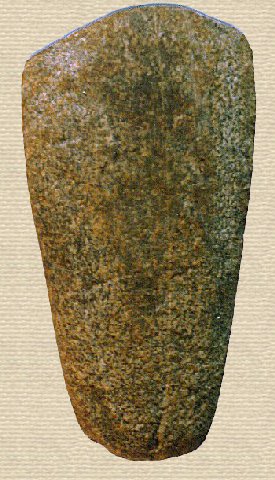
used. This is evidenced by the discovery of a wonderful amphibolite axe
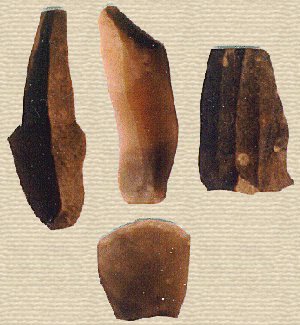
in the Waard-Nieuwland polder, and of a few small flint artifacts in Hippolytushoef
and Westerland. The flint objects were used as knives and scrapers.
 |
During the Neolithic, the first true cultures arose in the Netherlands.
In Drenthe, megalithic tombs were built by the "Funnel-Beaker Culture".
Near Slootdorp, in the Wieringer Lake area, a camp from this culture was
unearthed. It was part of a hunting camp that had been temporarily occupied.
The Wieringer Lake area was a perfect hunting ground during the late Stone
Age. The inhabitants came here for a while to hunt and then headed back
to their farms on the high, sandy plateaus of Groningen and Drenthe. Some
of these artifacts (hand-axes, arrowheads, pottery shards) are located
in "het Huis van de Aarde". |
| 3. The Bronze Age and the Iron Age. Next, there was
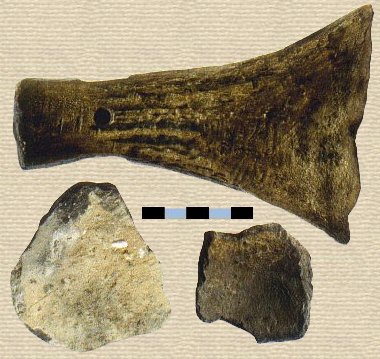
habitation during the Bronze age (2,000 - 600 B.C.) as evidenced by a few
fragments of pottery from Noordburen and Stroe, and a hook
from the nearby Wieringer Lake polder, fashioned out of moose (european
elk) antler.
There are even indications of habitation during the Iron Age, in the
form of pottery fragments and a very nice millstone found near Noordburen.
The Iron Age lasted from 600 B.C. until the year 0, when the Romans arrived
in this region (see nextpage). |
 |
|